Eating out in France: how it really works, decoded for newcomers
Eating out is one of the great pleasures of French life — and one of the easiest things to get quietly wrong when you've just arrived. Turn up hungry at three in the afternoon and you'll find every kitchen shut; wait politely for the bill and you'll wait all night; order an entrée expecting a main and you'll go home peckish. None of it is hard once you know the rhythms and the codes. Here's how the French table actually works — the meal times, the menus, the etiquette and the money — plus a plain-English tour of every kind of place, from the corner café to the farmhouse table.
The short version
- Eat when France eats. Kitchens serve lunch roughly 12h–14h and dinner from about 19h30 — and are firmly shut in between. Miss the window and it's café snacks or a supermarket.
- The fixed-price menu is the value play. A lunchtime menu du midi or formule gets you two or three proper courses for €13–20 — often half what the same food costs à la carte at dinner.
- Bread and tap water are free; the tip's already in the price. Ask for a carafe d'eau, and don't add 20% — service compris means service is included by law.
- Know your places. A café isn't a restaurant, a brasserie serves late, a bistrot hides the best cooking, and a rural ferme-auberge is the finest-value meal you'll eat all year.
The French take eating seriously — seriously enough that the meal has rules, and the rules are worth learning, because on the other side of them is some of the best, best-value food in Europe. Get the rhythm and the codes right and you unlock a national pastime; get them wrong and you go hungry surrounded by plenty. So let's decode it, starting with the single thing that catches every newcomer out: when France eats.
When France eats — and when it doesn't
This is the big one. France runs to strict meal times, and outside them the kitchen is genuinely closed — not "we'll see what we can do," but off, cold, done. Lunch is served from around midday to 2pm, dinner rarely before 7.30pm and typically 8pm onwards. In between, from about 2pm to 7pm, you will not get a hot meal in most places — the café next door will happily pour you a drink and maybe a croque-monsieur, but the restaurants are shut until evening service.
A few rhythms to bank. Cafés and bars stay open all day for drinks and coffee even when kitchens don't, so they're your fallback at odd hours. Many places close entirely on Sundays and Mondays — Sunday lunch is often the exception that's heaving, Sunday evening and all Monday frequently dead. Whole towns half-shut for August, when France goes on holiday. And in cities and tourist spots you'll increasingly find service continu — all-day service — but never assume it in the countryside. The golden rule: eat on French time, or carry a snack.
How a French meal is built
Open a menu and the logic is simple once you see it. A meal is entrée (starter), plat (main) and dessert — and crucially, an entrée is the first course, not your main, which trips up nearly everyone at first. You can order individual dishes à la carte, but the smart move is almost always the formule or menu: a fixed price for two or three set courses, far better value than piecing it together yourself.
The best-value meal in France is the menu du midi — the lunchtime fixed menu — where the same kitchen that charges dinner prices at night will feed you two or three courses for a fraction of it at noon. Look out for the plat du jour (the day's special, fresh and cheap), the fait maison mark (a little saucepan logo meaning the dish was cooked on site rather than reheated from a packet), and the café gourmand to finish. Here's the whole thing decoded — the menu on the left, the bill on the right.
The menu (la carte)
A formule or menu is a fixed price for a set number of courses — nearly always the best value, especially the lunchtime menu du midi.
An entrée is a starter, not the main event — the classic newcomer trap.
The plat du jour is the day's special — fresh, cheap and a good sign. Fait maison means cooked on site, not reheated.
A café gourmand is an espresso with a few mini-desserts — a lovely, light way to finish.
The bill (l'addition)
Tap water is free by law — ask for a carafe d'eau and skip the bottled.
Service — the tip — is already included by law. Round up or leave a couple of coins only if you really enjoyed it.
It won't arrive until you ask: catch the eye and say "l'addition, s'il vous plaît."
Know your café from your bistrot
"Let's eat out" means very different things depending on which door you walk through, and matching the place to the moment is half the skill. Open each for the plain-English version.
All dayCafé & bar-tabac — the all-day anchor
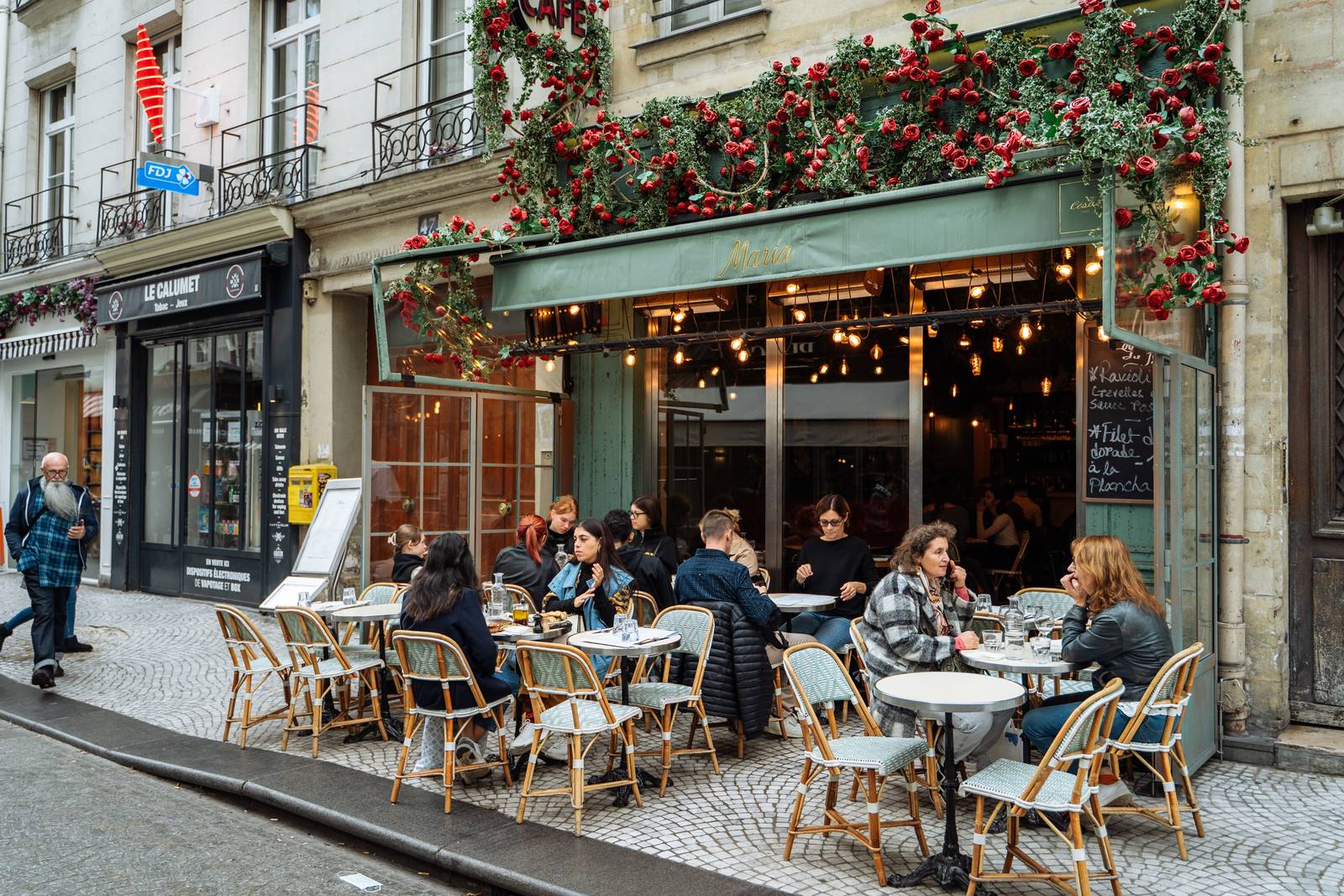
The default gathering place, open from breakfast to late. A coffee at the comptoir (bar) is cheaper than at a table, and cheaper again than on the terrasse — the same drink has three prices, all legal and printed on the wall. Simple food at lunch (a croque-monsieur, an omelette, a salad), drinks all day, and the tabac counter for stamps, lottery and bus tickets. Not a restaurant — don't expect a hot dinner — but the beating heart of the day.
Flexible hoursBrasserie — the reliable, longer hours
Literally a "brewery," now a big, buzzy, all-day restaurant that's your best friend when the rest of France has stopped serving. Brasseries often do service continu — food right through the afternoon — and a broad menu of classics: steak-frites, choucroute, seafood, big salads. Not the most refined plate in town, but dependable, quick and open when you're hungry at the wrong hour.
The good stuffBistrot — the small neighbourhood restaurant
Small, personal, often family-run, with a short handwritten menu and a proper plat du jour. This is where you'll eat some of your best, most honest French food — regional, seasonal, cooked with care — usually at a fair price, especially at lunch. Fixed meal times apply, so book or turn up on the dot.
Sit-downRestaurant — the proper sit-down meal
The full experience, from the modest to the Michelin-starred: set meal times, courses, a wine list, and a table that's yours for the evening — nobody will rush you or "turn" it. Look for the fait maison logo and a short, seasonal menu; be wary of laminated photo-menus in ten languages on the main square. Booking is wise, and essential at weekends.
Family & veg-friendlyCrêperie — Brittany's gift, and a cheap night out
Savoury buckwheat galettes then sweet crêpes, washed down with a bowl (yes, a bowl) of cider. Informal, quick, child-friendly and easy on the wallet — and one of the few places a vegetarian is reliably well fed. A brilliant default for a relaxed family dinner.
Rural gemFerme-auberge & table d'hôtes — eat at the farm
Out in the countryside, farms open their tables: a ferme-auberge serves a hearty, set, multi-course meal made largely from what the farm produces, often for a startlingly fair price. Booking ahead is usually required, and you eat what you're given — which is the whole joy. The most memorable, best-value rural meals you'll have; ask locals or the office de tourisme for the good ones.
Cheap & hugeRoutier — the lorry-drivers' lunch
The roadside relais routier exists to feed working drivers a huge, cheap, honest three-course lunch, fast. Look for the blue-and-red "Relais Routiers" sign, ignore the car park full of vans being a bad omen (it's the opposite), and eat like a king for the price of a supermarket sandwich. Lunchtime only, and all the better for it.
The unwritten rules of the table
None of these are tests you can fail — the French are far more relaxed about a foreigner finding their feet than the clichés suggest — but knowing them turns you from tourist to regular.
FreeBread, water and the things that are free
Bread comes automatically and goes straight on the table (not a side plate) — it's for the meal and for mopping up sauce, and it's fine to ask for more. Water: order a free carafe d'eau (tap water, which you're entitled to) rather than paying for bottled unless you want it. Neither is mean; both are completely normal.
Ask for itThe bill won't come until you ask
In France it would be rude to rush you out, so the bill simply won't appear until you request it — the table is yours for as long as you like. Catch your server's eye and say "l'addition, s'il vous plaît", or make a discreet little writing gesture in the air. Waiting silently for it to turn up is the single most common British misfire.
Slow downThe pace: lunch is long, and that's the point
A French meal is an event, not a pit stop. A good lunch can run two hours, courses arrive with space between them, and nobody's waiting for your table. Settle in, order a pichet (jug) of house wine, and match the rhythm rather than fighting it. Coffee comes after dessert, never with it, and "un café" means a small black espresso — ask for a café allongé if you want it longer, or a noisette for a dash of milk.
MannersKids, dogs and dressing the part
Children are welcome and expected to sit and eat like small adults — many places do a menu enfant, though don't expect a play area. Well-behaved dogs are often quietly welcome, even in smart rooms. And while France isn't stuffy, "smart casual" rarely goes wrong — the French dress up for a meal out a touch more than the British do.
Paying, tipping and the doggy-bag question
Money is where Brits most often tie themselves in knots, so here's the clear version. Service is included by law — that's what service compris means, and it's been the rule since 1987. You do not add 15–20% on top. For genuinely good service it's a kind gesture to round up or leave a few coins — in cash, since most card machines have no tip line — but it's a thank-you, not an obligation, and nobody chases you for it.
A few more paying quirks: small places often have a card minimum (€10–15) or are cash-only, so keep a note or two on you; splitting the bill item by item isn't very French, so it's easier to divide it evenly or take turns; and yes, you can now ask for a doggy bag. Since France's anti-waste law came in, restaurants must provide a container for your leftovers if you ask — though culturally the French still rarely do, so you may get a mildly surprised look along with your gambas. Ask anyway; it's your right and a shame to waste good food.
Eating well without overpaying — and the dietary reality
The value is all at lunch: the menu du midi, the plat du jour, the roadside routier and the rural ferme-auberge deliver the best food-per-euro in the country. To spot a proper place from a tourist trap, trust the good signs — a short, seasonal, handwritten menu, the fait maison logo, locals eating there, a plat du jour chalked on a board — and mistrust the bad ones: laminated photo-menus in five languages, a tout at the door, prime position on the honeypot square.
One honest caveat: vegetarians and vegans should arrive with expectations set. French menus are proud and meat-centred, and while cities now cater well and a crêperie or a good salad rarely fails you, deep-rural France can still meet "I don't eat meat" with genuine puzzlement. Learn the phrases — "je suis végétarien(ne)", "sans viande", "sans gluten" — flag allergies clearly, and you'll eat well; just don't expect the range you'd get in Bristol or Brighton everywhere you go.
Book a table — and often bag a discount
Most restaurants take bookings by phone, but the app most locals use is TheFork (owned by Tripadvisor): it shows who's got a table tonight, handles the reservation in English, and frequently offers real discounts — 20% or 30% off the à la carte at participating places, plus loyalty points. Worth a look before you ring around, especially in towns and cities.
See tonight's tables on TheFork →We're not paid to mention this — it's simply the app that works. If we ever add a paid affiliate link, we'll always say so plainly.
Where's a proper place near me — not a tourist trap?
The best table near you is the one a local Brit already swears by. The Pimpernel community is where to ask which village bistrot does a cracking plat du jour, which ferme-auberge is worth booking, and which pretty square to avoid. Real recommendations, from people who eat there.
Order like you've lived here for years
Pimpernel Life turns the first-timer's fumble into second nature — a pocket menu-and-phrase decoder for your phone, a members' directory of the bistrots, ferme-auberges and Sunday-lunch spots readers actually rate near you, and the local know-how that tells a fait-maison gem from a microwave on the main square.
- A menu & phrase decoder
- Members' local-restaurant picks
- Tourist-trap radar
Missing the tastes of home?
When it's a chippy or a Sunday roast you're after rather than a French menu, our homesick guide has the honest map — where to find British comforts, and where France quietly does it better.
Read: Homesick in France →The everyday stuff, decoded
Eating out is one ritual among many. Our everyday-France guide covers the rest of the small mechanics — the shops, the greetings, the unwritten rules nobody explains.
Read: Everyday France →Straight from the source
Two habits pay off everywhere: look for the fait maison saucepan logo on the menu, which means real cooking rather than reheated industrial food, and check availability on TheFork before you ring round — it's where the tables and the discounts are.
Meal times, prices, customs and the law here are current for 2026 and drawn from official and lived sources, but opening hours, menu prices and what a given place serves vary enormously by region, season and owner — and the countryside plays by stricter time rules than the cities. Treat this as a friendly briefing on how the French table works, not a guarantee about any particular restaurant. When in doubt, book ahead and eat on French time.