
Getting around France: trains, buses and the rural reality
France has some of the best trains in Europe and some of its emptiest country timetables — often in the same département. Between the cities you can live gloriously without a car; down a lane in the Gers you almost certainly can't. The trick is knowing which France you're in, using the brilliant bits properly, and planning honestly around the thin bits. Here's how the trains, buses and back-roads really work for a British household — and how to pay a lot less for them.
The short version
- City-to-city, the train wins. The TGV network is fast, civilised and, booked early or with a card, cheap. You can genuinely commute between big towns car-free.
- In the countryside, you'll still want a car. Rural rail is thin and buses are sparse — but a transport à la demande minibus and regional coaches fill more gaps than newcomers realise.
- Buy the €49 Carte Avantage. 30% off the fast trains, capped fares, and it pays for itself in two trips. There's a version for every age.
- You can get home to the UK by rail — Eurostar via Lille or Paris, then a TGV onward — which matters more than you'd think when you're choosing where to live.
Transport is one of those things nobody researches until they've signed for the house — and then it quietly decides whether daily life is easy or a grind. So here's the honest map of it: the brilliant fast trains, the thin rural gaps, the cheap ways nobody mentions, and the cards and apps that make the whole thing affordable.
Two Frances, one railway
The single most useful thing to understand is that France runs two transport systems wearing the same badge. There's the intercity network — the TGV spine that flings you between Paris, Lyon, Bordeaux, Marseille and the rest at the speed of a small plane — and there's local rural transport, which ranges from decent to frankly imaginary depending on your valley. Both are called SNCF; they feel like different countries. Plan your life around the fast network and you'll wonder why anyone drives. Plan it around a branch line that runs twice a day in term time and you'll be back in the car by Wednesday.
So the honest headline for most British arrivals, especially the rural romantics: the train is a joy for the big trips and the UK run, and a car is still the tool for daily life unless you've deliberately chosen a town with a proper station. Our guide to bringing and registering your car covers that other half.
The trains, decoded
Four names cover almost everything you'll ride. Open each for the plain-English version.
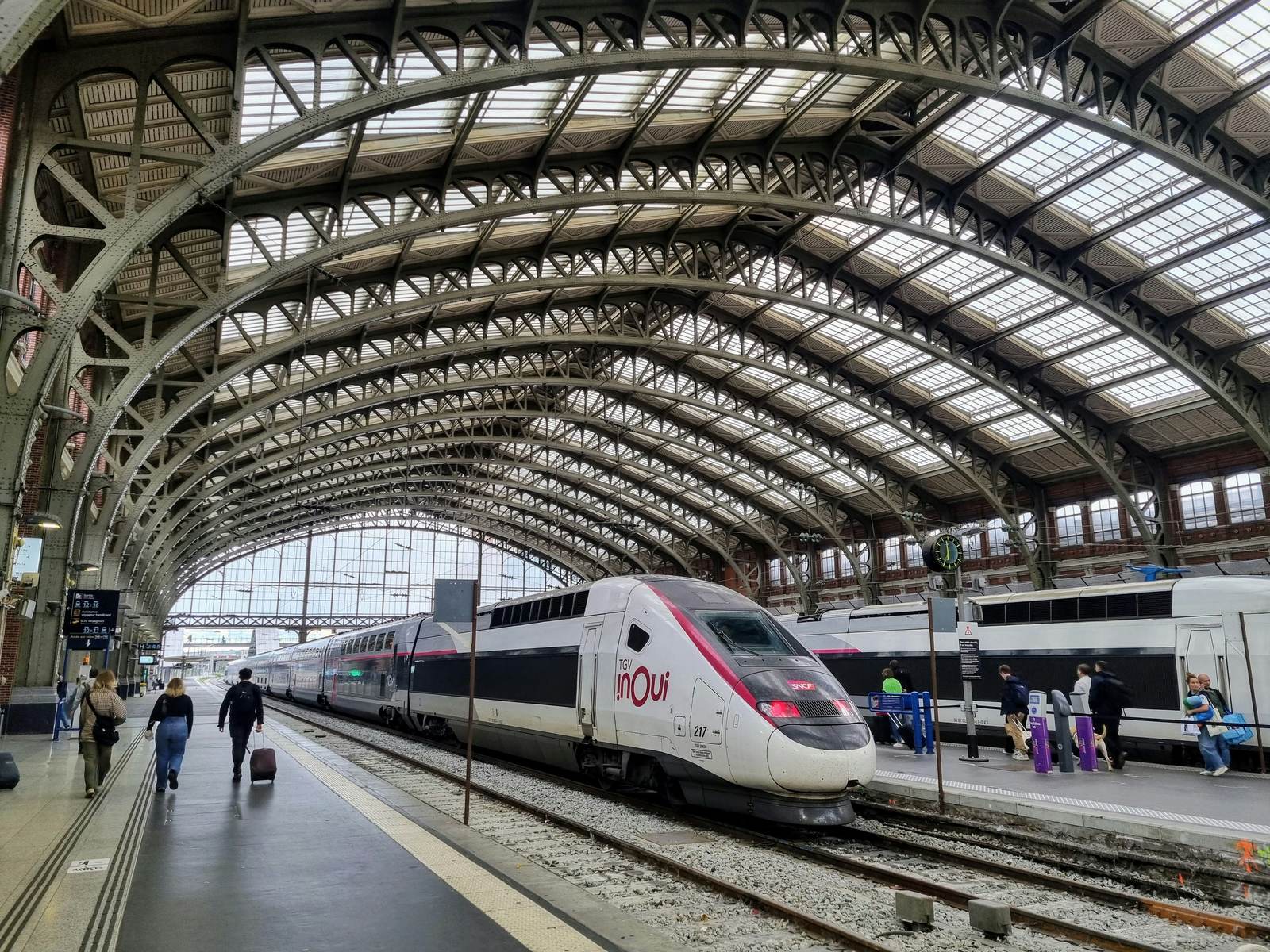
FastTGV INOUI — the fast, flagship trains
The famous high-speed trains, linking the big cities at up to 320 km/h. Paris to Lyon in two hours, Paris to Marseille in about three. Fares are like flights: cheap if you book weeks ahead, dear on the day. Reservation is compulsory — every ticket has a specific train, seat and time. Comfortable, quiet (there's a zone calme), and with a buffet car you'll overpay in.
BudgetOUIGO — the low-cost TGV
SNCF's budget high-speed brand: same speeds, rock-bottom fares (from €10–19 if you're early), but with catches. Some OUIGO trains leave from out-of-town stations (Paris Marne-la-Vallée, not Gare de Lyon), boarding closes 30 minutes before, luggage is limited, and everything — a bigger bag, a plug socket — is a paid extra. Brilliant value if you travel light and plan ahead; miserable if you turn up assuming a normal train.
Long-haulIntercités — the classic long-distance trains
Slower, older, cheaper long-haul trains on the routes the TGV doesn't cover — plus a small revival of trains de nuit (sleeper trains: Paris to the Alps, the Pyrenees, the Med). Not glamorous, but a genuinely lovely, low-carbon way to wake up in the south.
RegionalTER — the regional workhorses
The stopping, everyday trains, run by each région rather than by national SNCF. This is what you'll actually use to reach the market town, the airport or the coast. No reservation needed — turn up and go — and it's where the regional discount cards and passes (below) really pay off. Reliable on the main lines; sparse-to-nonexistent on the rural branches, which is the whole catch of country living.
Try it: how would you actually get there?
The map above is the whole network at a glance. This one answers a more specific question: pick where you are and where you're headed, and it traces the sensible route — which trains, roughly how long, and how many changes. It's a feel for whether a journey is a doddle or a proper slog, not a timetable — and when you're ready to book, it hands you straight to SNCF Connect for the real departures.
Your route
On the network
Click a town to set your destination. Faint lines are the rest of the principal network; hundreds of regional TER routes fill in between.
Paying a lot less: the Carte Avantage
If you take away one practical thing from this guide, make it this. The Carte Avantage costs €49 for a year and is the single best-value bit of admin in France. It hands you a guaranteed 30% off every TGV INOUI and Intercités journey, discounts on regional TER, and — the part that changes how you travel — a ceiling on the fare. Book a last-minute Paris–Marseille the night before and it still can't cost more than €89 in second class. Two return trips and it's paid for itself; after that it's just money back in your pocket. There's a card for every age, so a whole family can hold one.
27–59Carte Avantage Adulte — for 27 to 59
€49 a year, and it pays for itself in about two return trips. A guaranteed 30% off TGV INOUI and Intercités, 25–50% off TER depending on the region, and — the real prize — capped fares: no second-class TGV ticket costs more than €49 (under 1h30), €69 (1h30–3h) or €89 (over 3h), however late you book. It also lets you bring up to three children (4–11) with you at a heavily capped fare.
12–27Carte Avantage Jeune — for 12 to 27
Same €49, same 30% and the same fare caps, aimed at students and young travellers. If you've kids at that age heading back and forth to the UK or to a French university, it's a near-instant saving.
60+Carte Avantage Senior — for 60 and over
Again €49, the same discounts and caps, with a few extra senior perks. For retirees who'll point the car at the station and take the train to see the grandchildren, it's the obvious buy.
LocalRegional cards & season tickets
On top of the national card, each région runs its own TER deals — annual cards giving 50% off all year, flat-rate youth passes, and monthly abonnements for commuters. If you'll use one regional line regularly, ask at the station or on the region's TER site; the local card often beats the national one for local trips.
Book French trains in plain English
SNCF Connect is the official app and usually the cheapest, but its English can be clunky and UK cards sometimes bounce. Trainline sells the exact same SNCF tickets through a UK-friendly interface that just works with a British card and phone — a small booking fee for a lot less faff, especially while you find your feet.
Booking it without the headache
SNCF Connect is the official app and website (it replaced Oui.sncf), and it's usually the cheapest place to buy. Tickets live on your phone — no printing, just show the QR code — and your Carte Avantage sits in the app so the discount applies automatically. Two habits save the most: book early for TGV and OUIGO (fares climb as seats sell), and set a fare alert if you're flexible. If SNCF Connect's card handling or English frustrates you — it does bounce some UK cards — Trainline sells identical tickets through a friendlier interface for a small fee.
Buses, coaches and the very French art of the lift
Trains aren't the only way, and often aren't the cheapest. Three things worth knowing.
BlaBlaCar is carpooling, and in France it's mainstream, not fringe — a driver going your way sells the spare seats for a few euros. For rural cross-country hops the train ignores, it's frequently the fastest and cheapest option, and a surprisingly sociable one (the name is a joke about how much your driver chats). BlaBlaCar Bus and FlixBus run cheap intercity coaches — slow, but a fraction of a same-day train fare, and handy for airports. And don't overlook the région's own coaches, which use ordinary TER tickets and reach places the rails gave up on.
The rural reality — and how to soften it
Let's be straight: if you're an hour from a city, public transport will not run your daily life, and any guide that pretends otherwise is selling you something. But "you need a car" isn't the whole story, and the gaps are smaller than the silence suggests — because rural France hides its transport rather than advertising it.
RuralTransport à la demande (TàD) — the book-ahead minibus
The countryside's quiet secret. Many rural communautés de communes run an on-demand minibus: you ring or book online the day before, and it collects you from home (or a nearby stop) and runs you to the market town, the station or the doctor. Cheap — often a euro or two — and a lifeline if you don't drive. Ask at your mairieThe town hall — the first port of call for a huge range of local admin. what your commune offers; almost everywhere has something, but nobody advertises it.
CoachCars régionaux & school buses
Where rail branch lines have closed, the région runs cars (coaches) instead — same TER tickets, same passes. And the transport scolaire (school bus) network is dense and subsidised; in many areas the public can ride it too. Slow and term-time-only, but real.
The practical move when you're house-hunting: don't just ask "is there a station?" — ask the mairie what transport à la demande exists, how often the TER or coach actually runs, and how far the nearest airport is. Two households in the same département can have wildly different answers, and it's the difference between one car and two.
In the towns and cities
If you land somewhere urban, life gets easy fast. The bigger cities have metros, trams and dense bus networks, sold by the local operator on a rechargeable card or straight from your phone, with cheap monthly abonnements. In greater Paris it's the Navigo pass; elsewhere it's the local equivalent. Single tickets exist but a weekly or monthly pass almost always wins if you're staying put. It's genuinely possible — normal, even — to live car-free in a French city and not feel you're missing anything.
Getting home to the UK by train
This one quietly shapes where a lot of British families choose to live, so it's worth spelling out. Eurostar runs from London St Pancras to Lille (about 1h20) and Paris Gare du Nord (about 2h20). From Lille you can change onto a TGV straight down to Bordeaux, the south-west or the Med without setting foot in Paris — which makes Lille a very underrated hub for a car-free UK run. From Paris you cross town between stations (allow an hour) and pick up a TGV to almost anywhere. It's slower than flying, but civilised, luggage-generous, city-centre to city-centre, and it lets you bring the dog. For the trade-off between a nearby airport and a rail route home, our Where-to-live map is built precisely to weigh it.
Not sure a place works without two cars?
Before you fall for a house down a pretty lane, it's worth knowing honestly how car-dependent it really is — nearest station, the TER frequency, whether there's a TàD, how far to an airport that flies your UK airport. That's exactly what our Where-to-live work is built to answer.
Plan the whole move around how you'll actually get about
Pimpernel Life ties your transport reality into your personal plan — the station and airport access for your shortlisted areas, the licence-swap deadline, and a nudge before your Carte Avantage lapses. The practical side of France, watched for you.
- Airport & station access, scored
- Licence-swap reminders
- A living, personal plan
The other half of getting about
Most rural households still run a car. Our guide covers bringing yours over, re-registering it, and the contrôle technique — without the nasty surprises.
Read: Bringing your car to France →Choosing where to live?
Station access, airport routes home and how car-dependent an area really is are exactly what our map scores — tuned to the UK airports you actually use.
Open the Where-to-live map →Straight from the source
For timetables, fares and the Carte Avantage, SNCF Connect is the official booking site; your région's own TER site has the local passes and the rural coach and on-demand services.
Fares, card prices, discounts and services here are current for 2026 and drawn from SNCF and official regional sources, but rail pricing changes, capped-fare thresholds are periodically revised, and rural, on-demand and urban services vary enormously by commune and région — always confirm the current detail with SNCF Connect and your local TER and mairie. This is practical, general guidance to help you get around, not a timetable or a fare guarantee.